
By Delucio LLC · Editorial standards
In one sentence: Custom flooring is a wood floor designed for a specific home, with the species, board width, pattern, borders, and finish chosen and laid out to suit each room.
Key takeaways
- Custom work covers the layout, the material, and the finish, not only the pattern.
- Patterns, borders, and inlays need careful planning before installation starts.
- Site finishing lets you choose the exact color and texture of the floor.
What Custom Flooring Includes
Custom flooring is about choices that standard products do not offer. You decide the wood, the grade, and the board width, how the boards run through the house, and how the floor meets stairs, fireplaces, and doorways. The design is drawn around your rooms instead of around a box of planks.
It can be simple or detailed. A straight floor with mixed widths and a custom stain is custom, and so is a room framed with a border and a medallion. To compare the approaches, see our guide to custom vs standard flooring installation.
Herringbone and Chevron Patterns
Herringbone and chevron are the most requested custom patterns. In herringbone, rectangular pieces meet at right angles in a staggered zigzag. In chevron, the ends are cut at an angle so the pieces meet in a clean point. Both add movement and can make a narrow room feel wider.
Each pattern needs a centered starting line that relates to the walls, the doorways, and the main view into the room. The pieces are then cut and fitted by hand. Our herringbone flooring service explains how these layouts are planned.
Borders, Inlays, and Medallions
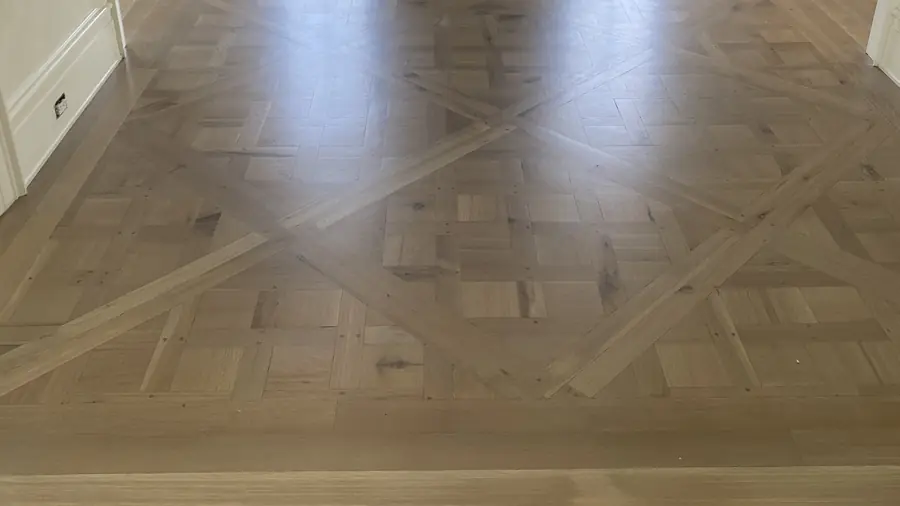
A border is a band of wood, often in a contrasting species or direction, that frames a room or follows its outline. Inlays add a smaller detail, such as a line of darker wood at an entry. A medallion is a decorative piece set into the floor as a focal point.
These details look most natural when they relate to the room around them, such as centering a medallion under a light fixture or following a border along a bay window. They are planned on paper first, then laid out on the subfloor before the field boards go in.
Choosing the Wood Species and Width
Species affects color, grain, and how the floor handles dents. Oak is common for its balance of grain, hardness, and response to stain. Harder woods resist dents better, while softer woods mark more easily but can bring a warm, lived-in character over time.
Board width changes the feel of a room. Wide planks look calm and relaxed, while narrower boards look more traditional and move less with the seasons. For wide boards or rooms over a slab, engineered wood can be a stable base for a custom design.
Custom Stain, Sheen, and Texture
When a floor is finished on site, the stain can be blended to match a color you choose, tested on the actual wood in your home. Sheen ranges from matte to glossy, and lower sheens hide small scratches and footprints better in busy rooms.
Texture is another option. Wire-brushing raises the grain for a more natural, tactile feel, and hand-scraped surfaces add a rustic look. Test samples on the same wood and check them in daylight before deciding.
How a Custom Flooring Project Unfolds
A custom project starts with a conversation about the rooms, the style, and how the house is used. Next comes a plan for the layout and materials, followed by subfloor preparation, moisture checks, and time for the wood to adjust to the house.
Installation follows the plan, with patterns and borders set first. Then the floor is sanded, stained, and finished on site. Our custom flooring service covers how each stage is coordinated with homeowners and designers.
The Short Version
Custom flooring is a wood floor planned around your home, from species and width to patterns, borders, stain, and texture. Good planning and careful site finishing bring it together. Share your photos and ideas at a free in-home estimate, and we will help you turn them into a plan for each room.
Next steps