

Essential Maintenance Guide for Floor Stability in New Canaan

Preventing gaps, cupping, and squeaks after hardwood floor installation in New Canaan requires a technical understanding of hygroscopic behavior and environmental control. To ensure lasting stability, homeowners must maintain a relative humidity level between 35% and 55% and ensure the subfloor moisture content is within 2% to 4% of the hardwood planks at the time of fastening.
Professional techniques used by Delucio LLC, such as proper plank racking, the use of vapor retarders, and specialized cleat nailing, are vital to avoid structural failures. Addressing these factors during the transition into 2026 ensures your Connecticut property remains a quiet, gap-free, and high-value investment.
The Science of Dimensional Stability in Fairfield County
When a new floor is installed in the Gold Coast, it immediately begins to interact with the local atmosphere. In New Canaan, our homes face a unique challenge: the extreme swing from humid Atlantic summers to bone-dry, heated winters.
At Delucio LLC, we don’t just “lay boards,” we engineer a system that accounts for volumetric expansion. If the wood is forced to move beyond its elastic limit, you end up with the “Big Three” flooring failures: gaps, cupping, and the dreaded squeak. Understanding the mechanical properties of your chosen species is the first step in a quiet, beautiful home.
Why Wood Movement is Inevitable but Manageable
Wood is an organic, hygroscopic material. It never truly “dies”, it continues to absorb and release moisture from the air forever. When it absorbs moisture, it expands (leading to cupping), when it loses moisture, it shrinks (leading to gaps).
By implementing advanced moisture mitigation strategies, we create a buffer that allows the wood to settle into its environment. This involves more than just a quick check, it requires professional pinless moisture meters and a deep knowledge of the Equilibrium Moisture Content (EMC) specific to the 06840 zip code.
Eradicating Cupping: Managing Moisture from Below
Cupping occurs when the bottom of a wood plank has a higher moisture content than the top. This causes the edges of the board to rise higher than the center, creating a “concave” shape. In New Canaan, this is often seen in homes with humid crawlspaces or damp basements.
To prevent this, we must address the hydrostatic pressure and vapor drive coming from the foundation. If the subfloor is wet, even the most expensive White Oak will fail.
Subfloor Preparation and Vapor Retarders
The key to a cup-free floor is a dry substrate. We test the plywood subfloor or concrete slab rigorously. If the moisture levels are too high, we don’t proceed until the environment is stabilized.
| Technique | Purpose | Result in 2026 |
| Moisture Barriers | Stops vapor drive from the basement | Prevents edge lifting |
| Silicone Vapor Shield | Provides a clean, dry slip-layer | Quieter, flatter planks |
| HVAC Calibration | Controls top-side humidity | Consistent surface level |
The Danger of Sanding a Cupped Floor Too Soon
One major mistake in 2026 home renovations is sanding down a cupped floor before it has dried out. If you sand the “humps” off a wet board, once the board eventually dries, it will “reverse cup,” leaving you with a permanently ruined floor that is thin in the center.
Solving the Mystery of Gaps: The Battle Against Dry Air
While cupping is a summer problem, gapping is the hallmark of a Connecticut winter. When your furnace kicks on in New Canaan, the indoor air becomes extremely dry, pulling moisture out of the wood cells.
Small, seasonal gaps (the width of a dime) are often normal, but large, permanent gaps indicate a failure in the acclimatization process or a lack of proper environmental control.
Acclimatization: The Non-Negotiable Step
Proper Hardwood Floor Installation in New Canaan, CT depends on the wood being “introduced” to your home’s climate. We deliver the wood days, sometimes a week, before installation.
By allowing the wood to reach its EMC, we ensure that the boards are at their most stable state when they are nailed down. If the wood is installed while it is too wet, it will inevitably shrink once the winter heating season begins, leaving large gaps across your living room.
The Role of Whole-House Humidification
For luxury homes in Fairfield County, we always recommend a high-quality humidifier integrated into the HVAC system. Keeping your home’s relative humidity at a steady 45% year-round is the single best way to keep your floor tight and beautiful through 2026 and beyond.
Eliminating Squeaks: The Engineering of a Silent Floor
A squeak is the sound of two pieces of material rubbing together under friction. Usually, this is the hardwood plank rubbing against a loose subfloor, or the nail itself moving within the wood.
In older New Canaan colonials, structural settling often creates “voids” under the floorboards. Our goal during installation is to eliminate these voids and create a monolithic, silent surface.
Mechanical Fastening and Subfloor Stability
Before we lay a single plank, we inspect the subfloor fasteners. If the plywood is only nailed, we add screws to the floor joists to pull the substrate tight.
We use pneumatic cleat nailers instead of staples. Cleats allow for the natural slight movement of the wood without “backing out” or losing their grip, which is a primary cause of noise over time.
Adhesive-Assist for Wide Plank Floors
Trends in 2026 favor wide-plank flooring (7 inches or wider). Because these boards have more surface area, nails alone aren’t always enough to prevent movement.
We utilize an adhesive-assist method, where a high-quality, flexible silane-based polymer glue is applied in a serpentine pattern. This provides a “gasket” effect that prevents the wood from clicking or squeaking against the subfloor, regardless of seasonal shifts.
Technical Standards and Material Selection
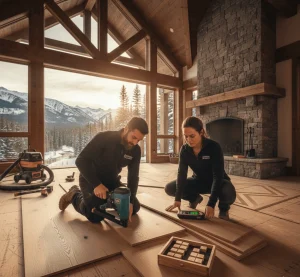
The species and cut of wood you choose will dictate how hard you have to work to prevent these issues. Some woods are inherently more stable than others in the volatile New Canaan climate.
Rift and Quartered vs. Plainsawn
Plainsawn wood is the most common, but it expands and contracts significantly in its width. Rift and Quartered wood is cut in a way that the grain is vertical, making it much more stable and far less likely to cup or gap.
| Wood Cut | Stability Level | Best Use Case |
| Plainsawn | Moderate | Standard residential projects |
| Quartered | High | High-humidity environments |
| Rift Sawn | Highest | Luxury wide-plank installations |
The Impact of the Janka Hardness Scale
Harder woods, like Hickory or Ipe, exert more force when they move. If they aren’t installed with the correct cleat frequency and environmental controls, they can actually pull up subflooring. Softer woods like Cherry are more forgiving but prone to “compression set” if they expand too tightly against a wall without a proper expansion gap.
Ongoing Care and Maintenance in 2026
Your relationship with your floor doesn’t end on the day of installation. To keep it quiet and flat, you must be a proactive steward of your home’s environment.
Monitor Humidity: Use a digital hygrometer to keep an eye on your indoor air.
Avoid Wet Mopping: Excessive water can seep into the grooves and cause edge swell.
Check for Leaks: A slow leak from a refrigerator or a window can cause localized cupping that ruins an entire room.
Expert Consultations with Delucio LLC
We pride ourselves on our EEAT approach. Our expertise in wood science allows us to predict how a specific species will behave in your home. We provide every client with a detailed “Home Health” guide to ensure their floors remain in peak condition.
Why Local Knowledge Matters in New Canaan
A contractor from outside Fairfield County might not understand the geological and atmospheric pressures of our area. From the rock-solid foundations in Silvermine to the coastal moisture of Rowayton, we know how to adjust our installation techniques to suit the micro-location.
We are committed to delivering a product that doesn’t just look good in the brochure, but performs flawlessly in your daily life. Our reputation is built on structural longevity and meticulous craftsmanship.
Frequently Asked Questions About Floor Failures
Can I fix a squeak without replacing the whole floor?
Yes, often we can use “top-down” repair kits or inject specialized resins into the void. However, the best cure is prevention through proper subfloor fastening during the initial install.
Is it normal for my floor to have gaps in January?
In New Canaan, minor gaps are common in the winter. If you can fit a credit card into the gap, it’s normal seasonal movement. If you can fit a nickel, you likely need more humidity in your home.
How do I know if my cupping is permanent?
If the moisture source is removed and the floor is allowed to dry slowly (sometimes over a full season), it may flatten out on its own. Never sand a cupped floor until a moisture meter confirms it is dry.
Secure Your 2026 Installation
Ready to invest in a floor that stays quiet, flat, and beautiful? Your flooring is a long-term investment in your home’s value, and achieving a professional result requires a deep understanding of wood behavior and structural preparation. By letting our specialists handle every technical detail, you ensure a stress-free transformation that stands the test of time.
To guarantee a flawless and high-performing floor for your 2026 project, we prioritize:
Structural Precision: We conduct thorough site evaluations to ensure your subfloor is perfectly level and prepared for a quiet, movement-free installation.
Environmental Acclimation: Our team meticulously manages the moisture content and acclimation of your hardwood to prevent future warping, gaps, or buckling.
Superior Craftsmanship: We combine advanced installation techniques with premium materials to deliver a surface that remains structurally sound and visually stunning for years to come.
Don’t leave the foundation of your home’s aesthetic to chance. Contact us today to schedule your professional site evaluation and take the first step toward a superior flooring experience, or call us directly at: (475) 284-8583

